

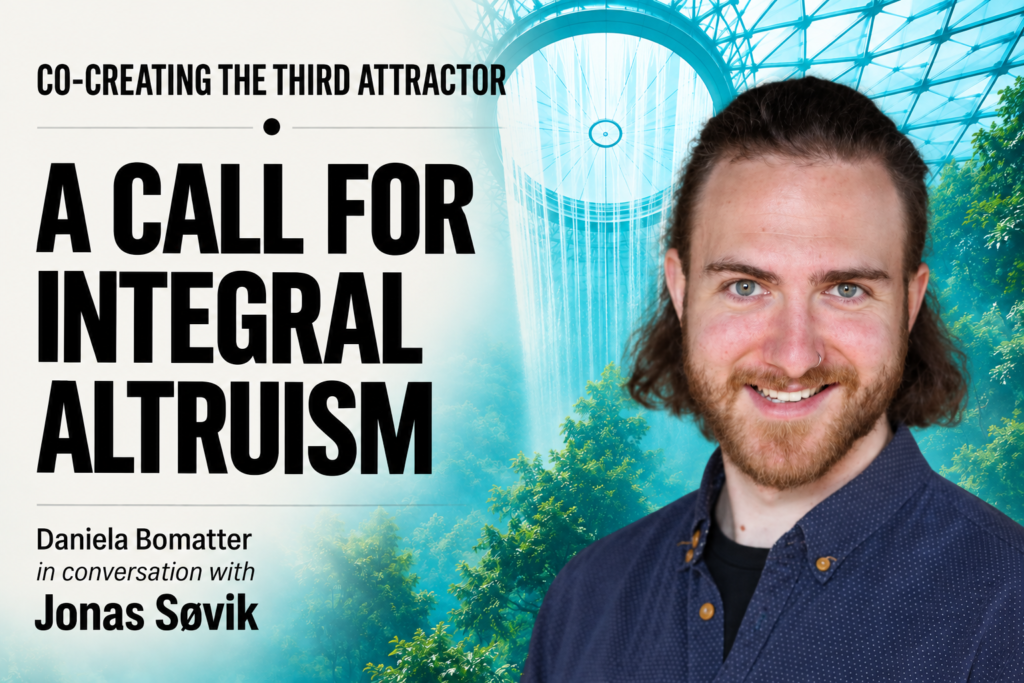
Jonas Søvik is a coach, facilitator and community builder working on the integration of effective altruism with traditions it has tended to exclude. He is a co-organiser of Integral Altruism, an initiative that brings systems thinking, wisdom practice, metarationality and metamodernism into contact with the EA framework. The premise is a diagnosis rather than a rejection: effective altruism carries specific blind spots inherited from classical utilitarianism, naive rationalism and techno-solutionism, and those blind spots become liabilities when the problems in question are complex and unfolding under radical uncertainty. Integral Altruism runs residential retreats, an online speaker series and regular gatherings in London, Berlin and Paris, along with experiments in hackathons, conferences and practice circles.
His institutional footing is inside the movement he is trying to widen. He has served on the board of EA Denmark and worked at the EA Hotel in Blackpool, a low-cost residential hub for people doing altruistic work outside conventional funding structures, where he helped restructure and expand the organisation. He is also a network expert with the Institute of Applied Metatheory.
His formative influences sit on the other side of that bridge. He has worked with John Vervaeke, appearing in conversation with him on the folk high school tradition and cultural change, and with Lene Rachel Andersen, whose work on Bildung and metamodernity connects nineteenth-century Danish popular education to the current meaning crisis. He has also volunteered with Life Itself. His stated long-term aim is to found a folk high school or academy combining metacrisis literacy, effective altruism and wisdom practice, a proposal that takes the historical Scandinavian model of education for citizenship rather than employment and applies it to present conditions.
Alongside this he runs Coaching for Humans, offering coaching, workshops, retreats and a six-week programme on regaining control of screen time, built on the position that attention capture is engineered and therefore requires structural rather than moral remedies. He describes his own orientation as spiritual and analytically committed in equal measure, and he is one of the younger voices in this field, which he has used deliberately in reverse-mentoring relationships with older thinkers.
Links: integralaltruism.com, coachingforhuman.com, appliedmetatheory.org
Two things worth knowing before you record. He was recently a guest on Manda Scott’s Accidental Gods podcast, so the two conversations are directly linked and you could use that. And Integral Altruism’s reading list includes the Evolving Effective Altruism dialogue by Jonah Wilberg and Rufus Pollock, who you have already interviewed.