
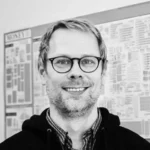

James B. Glattfelder is a theoretical physicist turned complexity scientist whose work runs from the architecture of global financial power to the metaphysical foundations of science itself. He holds an M.Sc. in theoretical physics and a Ph.D. in the study of complex systems, both from the Swiss Federal Institute of Technology in Zurich. He spent sixteen years in the traditional finance industry alongside work in the distributed ledger ecosystem, and was a postdoctoral researcher at the University of Zurich.
His entry point into complexity was a question: we understand the physical universe with striking precision, so how might we reach a comparable understanding of human society? In 2011 he co-authored “The Network of Global Corporate Control,” which mapped the architecture of ownership across roughly 43,000 transnational corporations and computed how much control each player actually exerted. The study identified a small cluster of firms, mostly banks, holding disproportionate influence over the global economy, and it circulated widely during the Occupy movement. It remains one of the few empirical answers to a question usually argued ideologically.
His later writing turns from networks to ontology. He is the author of “Decoding Complexity: Uncovering Patterns in Economic Networks,” “Information, Consciousness, Reality: How a New Understanding of the Universe Can Help Answer Age-Old Questions of Existence,” and “The Sapient Cosmos: What a Modern-Day Synthesis of Science and Philosophy Teaches Us About the Emergence of Information, Consciousness, and Meaning.” The argument across these books is that the ontology of reality is information-theoretic and participatory, yielding a universe that is computational and programmable. He treats physicalism not as a finding of science but as a metaphysical choice made early and rarely re-examined, and points to two domains science left outside its inquiry: the formation of complex metabolic structures that appear to run against cosmic decay, and consciousness itself.
His broader case is that we have built systems that have outgrown our capacity to understand or steer them, and that complexity science offers a shift away from analysing the nature of things toward understanding the networks of interdependence that produce them. He lives in Zurich.
Website: https://jth.ch/jbg