

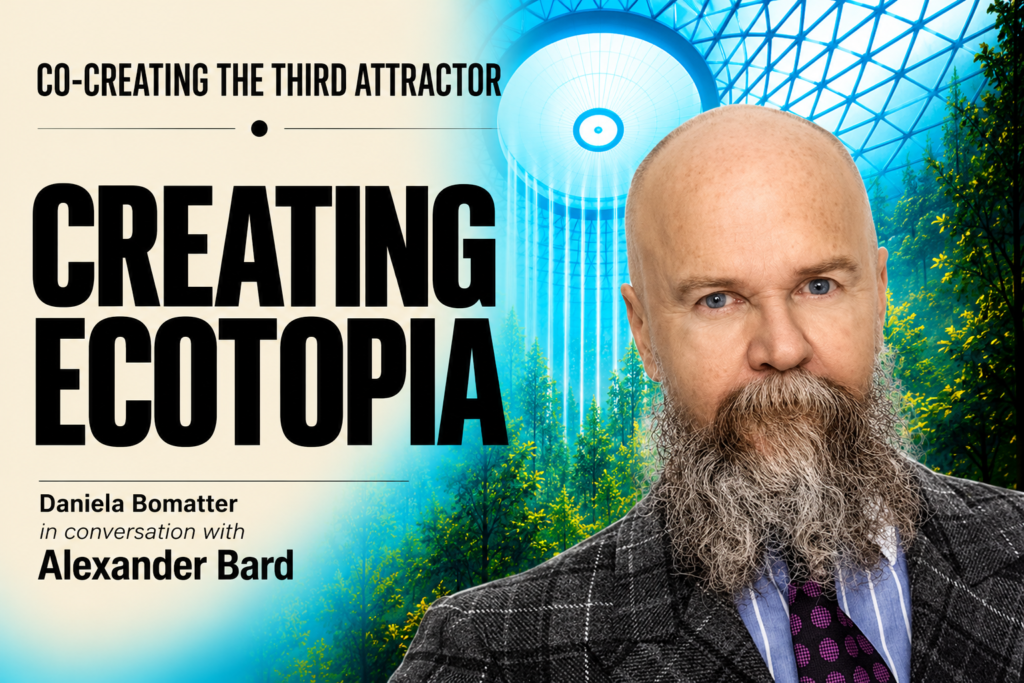
Alexander Bard is a Swedish philosopher, author, lecturer and music producer whose work examines how information technology reshapes power, identity and religion. Born in 1961 in Motala, Sweden, he studied in the United States and Amsterdam before attending the Stockholm School of Economics from 1984 to 1989, while pursuing philosophy and social theory with the explicit aim of becoming a writer and lecturer in those fields.
For three decades he was one of Scandinavia’s most prolific pop creators. He founded Army of Lovers, whose hits Crucified and Obsession reached audiences across Europe and became especially successful in Eastern Europe, and later the projects Vacuum, BWO and Gravitonas. He co-founded Stockholm Records and wrote and produced for many Swedish artists. To a wide Swedish audience he is also known as a judge on Idol and Talang.
His philosophical work, written with media theorist Jan Söderqvist, began with The Netocrats (2000), translated into 17 languages, which reads history as a sequence of information technologies, each producing its own ruling class. Where print gave rise to academics, politicians and capitalists, the internet produces a new elite, the netocracy. The Global Empire and The Body Machines completed what became the Futurica Trilogy. A second series followed: Syntheism: Creating God in the Internet Age (2014), which proposes participatory culture as the spirituality of the digital age and draws on Whitehead and Bohr to argue for a radical relationalism against the individualism of late capitalism; Digital Libido (2018), a Freudian and Nietzschean critique of infantilisation and existential crisis in network society; and Process and Event (2023), on the metaphysics of cyclical and linear time and the history of religious thought up to artificial intelligence.
Bard co-founded the Syntheist movement and has practised Zoroastrianism since 1992, placing it with Taoism and Buddhism in what he calls the Silk Route Triad. He has lectured internationally since 1997, including several TEDx talks, and his current teaching centres on consciousness, existentialism and the “sociont”, his term for the networked collective being that emerges in the digital age. He is a direct and often provocative thinker, bringing an unusual mix of pop industry experience, economics and metaphysics to questions of where civilisation is heading.