A reflection on the four most recent episodes of Co-Creating the Third Attractor
The last four conversations in this series brought together people with very different backgrounds: Alexander, filmmaker and writer; Aterah, integrative health researcher and contemplative practitioner; Tom, clinical psychologist and organizer of the ICON conference; and Cordula, author and deep ecology practitioner. They have not worked in the same communities, do not share a common intellectual lineage, and approached the questions of this series from distinct angles. What surprised me, listening back, was how consistently they converged on the same underlying problem.
The problem is not diagnosis. All four are clear enough about what is wrong. Alexander’s documentary Leviathan makes the case that Western civilization has inverted the hierarchy of reality, placing abstraction at the center (financial instruments created from nothing, ideologies never directly experienced, AI systems opaque even to their builders) while what people actually value most is pushed to the margins. Cordula, drawing on Jean Gebser, describes the current crisis as the exhaustion of the mental-rational structure of consciousness: the mode that organizes everything through analysis and the subject-object divide, and that has been running well past its useful range. Aterah locates the problem in systemic instability, where the two visible attractors (chaos and authoritarianism) are both pulling on people’s fear responses, leaving the third possibility quiet and underrepresented. Tom works at the level of groups and asks why moments of genuine collective coherence remain fragile, why the integral community can generate extraordinary we-space in a conference room and then watch it dissolve when things get difficult.
Different framings, but the same underlying question: what does it take for genuine transformation to hold, not as a peak experience, but as a functioning way of being?
Each of them, in their own vocabulary, points to a distinction between a self that is contracted into its habitual frame and one that has genuinely opened to something larger. Alexander calls it returning to the primacy of lived embodied experience over abstraction. Aterah calls it non-separation: when it truly lands that we are not divided from nature, from others, from the larger process, the motive for action changes entirely. Tom calls it operating from the authentic self rather than the defended self, and argues that this is a collective skill as much as an individual one. Cordula’s formulation is the most radical: she is not asking how to build a better human-centered civilization, but whether the impulse to be the designer and creator is itself part of the problem. Her phrase was “giving ourselves to the creation,” an active participation in a process that was not originated by human intention and cannot be fully controlled by it.
These are not the same answer. But they illuminate the same gap.
What none of them are willing to settle for is transformation that only shows up under favorable conditions. Alexander is explicit that the relational practices most people in the consciousness world favor tend toward the parasympathetic, the calm, the coherent end of human contact. But real relationship also includes activation, friction, and the aliveness that comes when the sympathetic nervous system is engaged. Learning to remain present and generative in that state, rather than only in the soft-coherence version, is a different and harder practice. Tom makes the same point from his clinical background: he has spent years working with couples who say they want genuine intimacy but flinch, giggle, or regress the moment real exposure becomes possible. Building the capacity to stay present under that intensity is slow work, and it accumulates through consistency more than through insight.
The question of whether inner development translates into changed outer behavior came up in several of these conversations, and the honest answer was: not automatically. At the retreat we held here in Tiruvannamalai in January, one of the clearest moments was when a group working through the four quadrants arrived at the upper right (observable behavior) and recognized that all the inner development in the world leaves no visible trace unless it shows up in how a person actually acts: how they treat food, nature, strangers, disagreement. Aterah’s research in integrative health is trying to address this directly, pairing mindfulness practice with explicit sustainability behaviors and measuring what shifts. The two seem to reinforce each other, but the connection does not happen by itself.
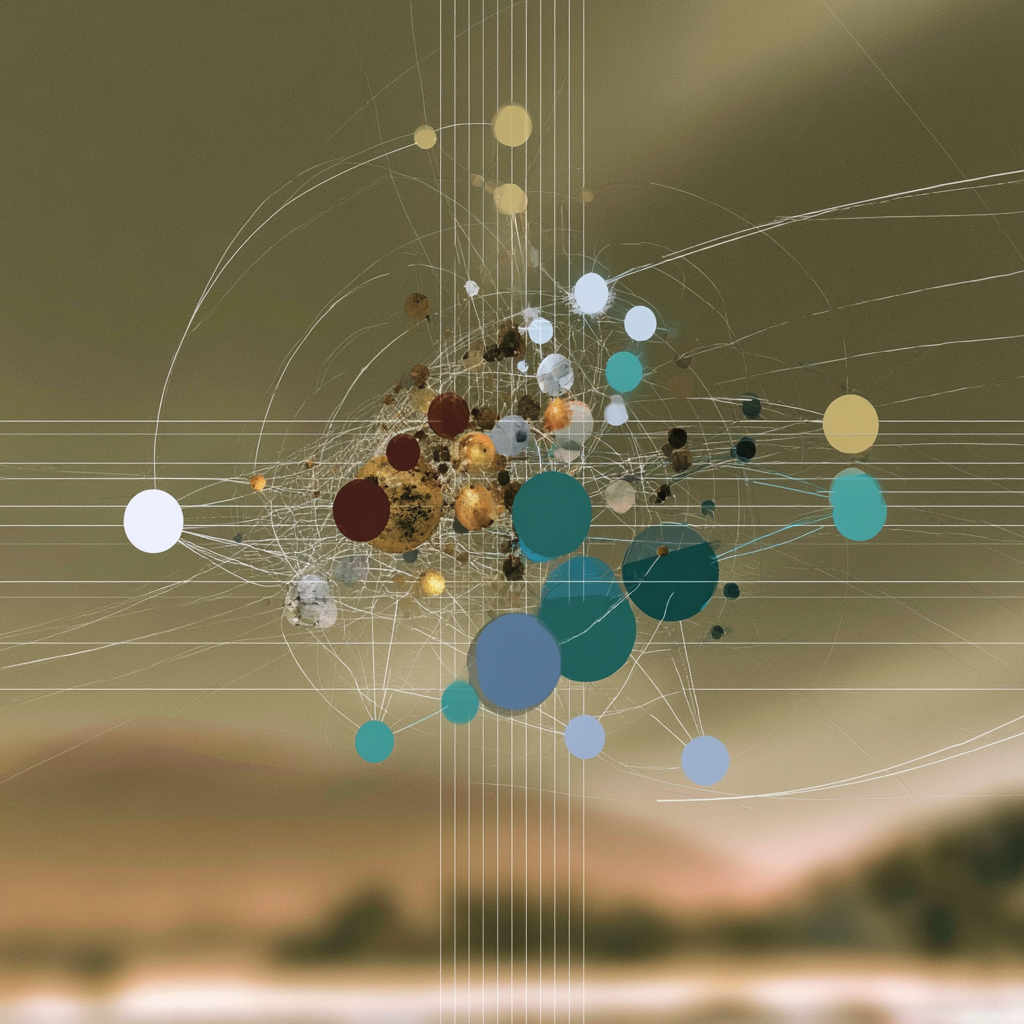
Aterah also introduced the systems framing that I find most useful for the question of scale: Prigogine’s dissipative structures, the idea that in a destabilized system, islands of coherence do not merely survive, they can flip the entire system. You do not need to reach everyone. You need coherent nodes at the right leverage points, connected to each other, where influence propagates through the network. This reframes what small groups working seriously are actually doing. It is not marginal. It may be exactly the mechanism through which large systems shift.
The question of what sustains those nodes is where Cordula’s contribution is most pointed. She does not believe the answer is more mental effort, more design, more strategy. The practices she returns to are ones that interrupt the mind’s habitual priority: listening before responding, attending to what wants to emerge rather than what has already been decided. She refers to Daniela’s novel The Viratya Myth begins as an attempt to transmit this through narrative precisely because she distrusts argument as a form. Argument is mental. What she is pointing toward operates differently, and she is honest that she does not know how to guarantee that the impulse to participate in something larger does not quietly become another project of the small self, dressed in better language.
That honesty is, I think, one of the more valuable things these conversations offer. None of these four people are presenting a solution. They are each working seriously on one part of a problem that is larger than any of them. The convergence across their different starting points suggests that the question is real and that the direction matters, even if the full answer is not yet in view.
Cordula put it simply near the end of our conversation: her Third Attractor would be to stay awake while the trance is everywhere, and to have developed the capacity to hold the loneliness that comes from seeing clearly in a context that does not yet share that clarity. I have been thinking about that since. It is not a program. It is a description of what the work actually asks of a person.
That is what this series, now past its thirtieth conversation, is still in the process of exploring.