

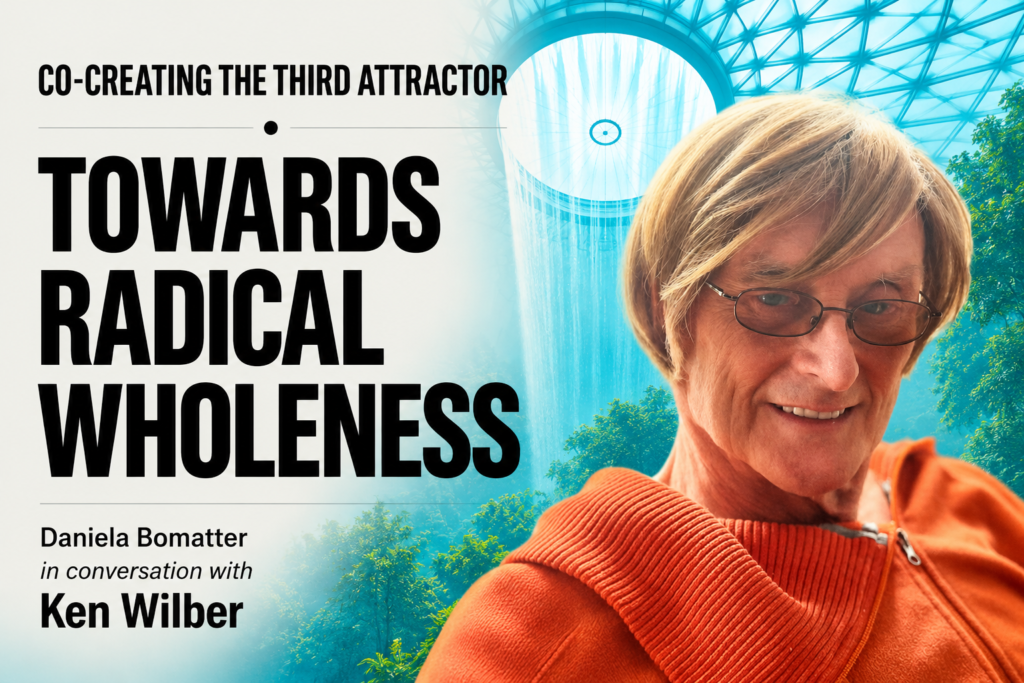
Ken Wilber is an American philosopher whose work has centered on building a comprehensive framework for understanding human development, consciousness, and the relationship between interior and exterior dimensions of reality. Beginning with his 1977 book The Spectrum of Consciousness, he set out to synthesize insights from developmental psychology, contemplative traditions, systems theory, and evolutionary biology into a single integrative model.
His most widely known contribution is Integral Theory, formalized through the AQAL framework (all quadrants, all levels). This model maps experience across four quadrants: individual interior, individual exterior, collective interior, and collective exterior, paired with stages of developmental complexity drawn from thinkers like Jean Gebser, Clare Graves, and later Spiral Dynamics. The framework attempts to hold subjective experience, behavior, culture, and social systems as equally real and mutually irreducible domains, rather than privileging one over the others.
Wilber’s major works include Sex, Ecology, Spirituality (1995), A Brief History of Everything (1996), and Integral Spirituality (2006). His writing draws on a wide range of traditions, from Vedanta and Buddhism to Western philosophy and developmental psychology, and he has spent decades refining how these can be understood as partial but valid perspectives within a larger developmental arc rather than competing truth claims.
He founded the Integral Institute in 1998 to bring the framework into applied contexts including psychology, ecology, business, law, and education. Integral Theory has since influenced fields well beyond philosophy, shaping approaches in organizational development, coaching, and political theory, and it remains a frequent reference point in conversations about how humanity might develop the cognitive and cultural capacity to address complex, interlocking global challenges.
For the Third Attractor context: Wilber’s framework offers a structural account of why different worldviews interpret the same crises so differently, and why any viable third path likely requires matching developmental complexity in human interiors to the complexity of the systems we are trying to navigate.