

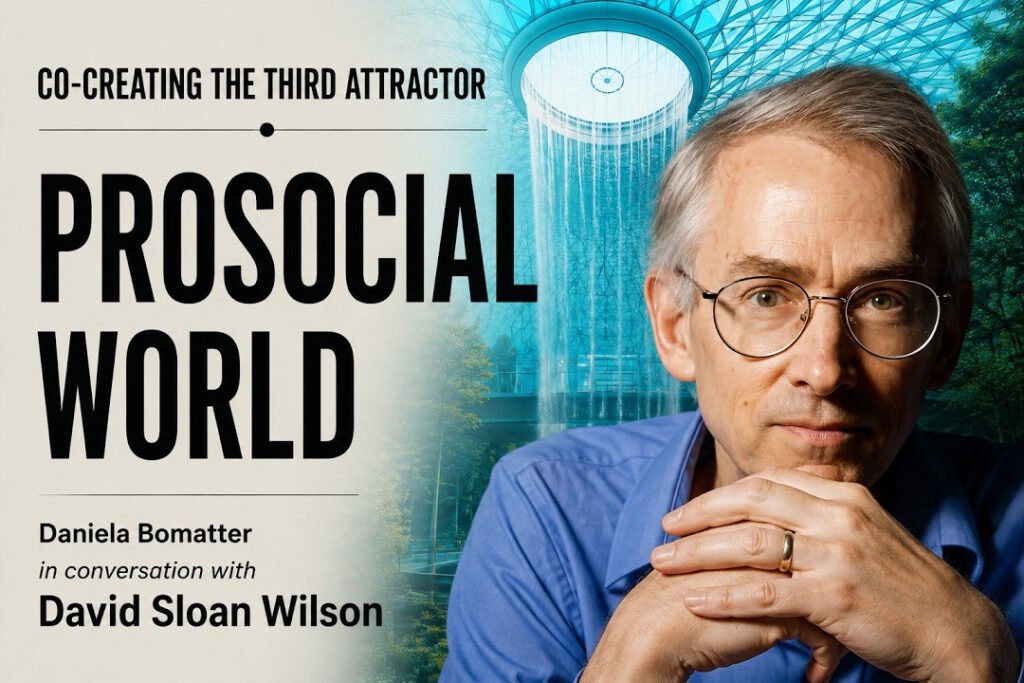
David Sloan Wilson is an evolutionary biologist and Distinguished Professor Emeritus of Biological Sciences and Anthropology at Binghamton University, where he taught from 1988 until his retirement in 2019. He took his B.A. at the University of Rochester and his Ph.D. at Michigan State University in 1975, and held research posts at Harvard, the University of the Witwatersrand, and UC Davis before settling at Binghamton.
He is the leading proponent of multilevel selection theory, developed with the philosopher Elliott Sober in their book “Unto Others.” The claim is that natural selection operates on a nested hierarchy of units: genes within individuals, individuals within groups, groups within populations, and even ecosystems within multi-ecosystem populations. Each level produces adaptations at that level, and each tends to be undermined by selection at the level below. This overturns the assumption that cooperation must be explained away as disguised self-interest. It becomes instead a real evolutionary outcome, though one that survives only when the conditions at the higher level hold. The corollary is uncomfortable and central to his work: groups that function well internally can be ruthless toward each other, so the question is never whether cooperation is possible but at what scale it is being organised.
He founded the Evolutionary Studies (EvoS) program at Binghamton to unify disciplines under evolutionary theory, with students taking evolution-themed courses across biology, anthropology, psychology, bioengineering, philosophy and religion. His books span that range, including “Evolution for Everyone: How Darwin’s Theory Can Change the Way We Think About Our Lives.” He also describes himself as an enthusiastic proponent of the extended evolutionary synthesis.
He co-founded the Evolution Institute and its spinoff nonprofit Prosocial World, which takes the theory into practice: applying multilevel selection alongside Elinor Ostrom’s design principles for managing common resources to help real groups, from businesses to schools to communities, function as genuine cooperative units. This is the point where his work bears directly on the third attractor question, since it treats the scaling of cooperation as an empirical design problem rather than a moral appeal.
Archive: https://davidsloanwilson.world
Prosocial World: https://www.prosocial.world